
Yield: 1 large 9×5-inch loaf
Prep time: 20 minutes
Bake time: 50–60 minutes
Total time: about 1 hour 20 minutes
🛒 Ingredients
Main ingredients
- 2 cups all-purpose flour
- 1½ cups freshly grated zucchini
- 1 cup granulated white sugar
- ½ cup vegetable oil
- 2 large eggs
- 1 teaspoon pure vanilla extract
- 1 teaspoon baking soda
- ½ teaspoon baking powder
- ½ teaspoon salt
- 1 teaspoon ground cinnamon
- ¼ teaspoon ground nutmeg
Optional ingredients
- ½ cup chopped walnuts
- ½ cup chopped pecans
- ½ cup chocolate chips
- ¼ teaspoon ground cloves
- ½ teaspoon orange zest
For the pan
- 1 teaspoon butter or vegetable oil
- 1 tablespoon flour, optional for dusting the pan
👩🍳 Detailed Directions
1. Preheat the oven.
Begin by preheating your oven to 350°F (175°C).
Give the oven enough time to reach the correct temperature before putting the zucchini bread inside.
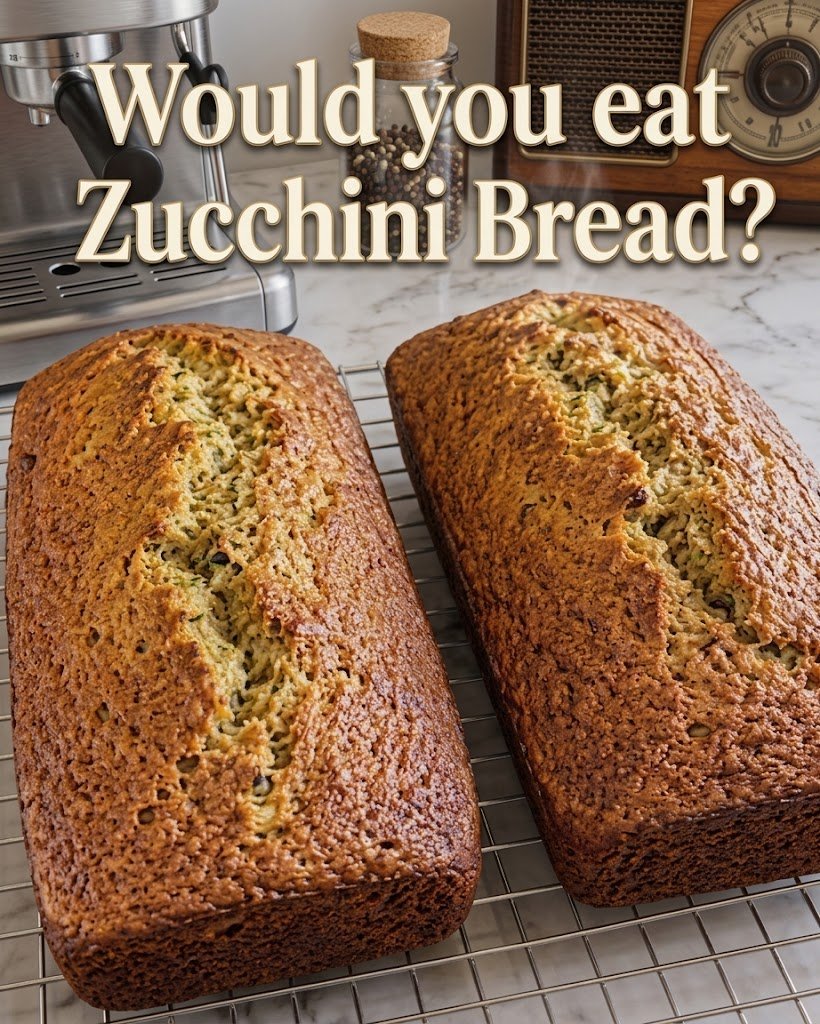
A properly preheated oven helps the loaf rise evenly and develop that beautiful cracked top seen in the photograph.
2. Prepare the loaf pan.
Use a 9×5-inch loaf pan.
Grease the bottom and sides generously with butter or vegetable oil.
Make sure you reach the corners because zucchini bread can stick as it bakes.
3. Dust the pan with flour.
For extra insurance against sticking, sprinkle approximately 1 tablespoon of flour into the greased pan.
Tilt and rotate the pan until the flour lightly coats the bottom and sides.
Turn the pan upside down over the sink and tap out any excess flour.
You can also line the pan with parchment paper, leaving some paper hanging over the sides so the finished loaf can be lifted out easily.
4. Prepare the zucchini.
Wash 1½ cups of fresh zucchini thoroughly.
There is no need to peel the zucchini.
The green skin adds little flecks of color throughout the finished loaf.
5. Grate the zucchini.
Use the medium or large holes of a box grater.
Grate the zucchini directly into a bowl.
You want relatively fine strands that will distribute throughout the bread.
6. Measure the zucchini after grating.
This recipe uses approximately 1½ cups grated zucchini.
Don’t measure a whole zucchini before grating because zucchini sizes vary considerably.
Measure the grated zucchini after preparing it.
7. Lightly squeeze the zucchini.
Place the grated zucchini in a clean kitchen towel or use your hands to gently squeeze it.
Remove some of the excess water, but don’t squeeze the zucchini completely dry.
Zucchini contains a lot of water, and that moisture is important for creating tender bread.
The goal is simply to remove excess liquid that could make the loaf too wet.
8. Set the zucchini aside.
Once lightly squeezed, place the zucchini in a bowl and set it aside.
Don’t worry if it still feels moist.
That moisture will help keep the finished zucchini bread soft.
9. Prepare the wet ingredients.
In a large mixing bowl, crack 2 large eggs.
Add 1 cup granulated sugar.
Whisk them together until the mixture becomes smooth and slightly lighter in color.
10. Add the vegetable oil.
Pour ½ cup vegetable oil into the egg-and-sugar mixture.
You can use canola oil, sunflower oil, or another neutral-flavored cooking oil.
Oil is particularly useful in zucchini bread because it produces a very moist texture.
11. Add the vanilla.
Add 1 teaspoon vanilla extract.
Vanilla enhances the cinnamon and nutmeg and gives the bread a warm bakery-style aroma.
12. Mix the wet ingredients.
Whisk the eggs, sugar, oil, and vanilla together until everything is thoroughly combined.
The mixture should look smooth and slightly glossy.
Don’t worry if the sugar isn’t completely dissolved.
13. Add the zucchini.
Add the 1½ cups lightly squeezed grated zucchini to the wet mixture.
Use a spatula or wooden spoon to stir it through.
Make sure the zucchini is distributed evenly rather than forming large clumps.
14. Prepare the dry ingredients.
In a separate medium-sized bowl, add 2 cups all-purpose flour.
Add 1 teaspoon baking soda, ½ teaspoon baking powder, and ½ teaspoon salt.
These ingredients provide the structure and lift for the loaf.
15. Add the cinnamon.
Add 1 teaspoon ground cinnamon to the flour mixture.
Cinnamon is one of the main flavors in classic zucchini bread.
If you love cinnamon, you can increase it slightly to 1¼ teaspoons.
16. Add the nutmeg.
Add ¼ teaspoon ground nutmeg.
Nutmeg adds a subtle warm, slightly sweet spice that works particularly well with zucchini.
Don’t use too much because nutmeg can become overpowering.
17. Mix the dry ingredients.
Whisk the flour, baking soda, baking powder, salt, cinnamon, and nutmeg together.
Mix thoroughly so the baking soda and spices are evenly distributed throughout the flour.
This is important because you don’t want a concentrated pocket of baking soda or cinnamon in one part of the loaf.
18. Combine the dry and wet ingredients.
Gradually add the dry ingredients to the zucchini mixture.
Use a spatula or wooden spoon rather than an electric mixer.
19. Stir gently.
Mix until the flour has just disappeared.
Do not keep stirring once the batter is combined.
Overmixing develops gluten and can make the finished zucchini bread dense or chewy instead of tender.
A few tiny lumps are perfectly fine.
20. Add the nuts.
If you’re using walnuts or pecans, fold ½ cup chopped nuts into the batter.
Walnuts provide a slightly earthy flavor, while pecans give a sweeter, buttery flavor.
Either one works beautifully.
21. Add chocolate chips if desired.
For a dessert-style zucchini bread, fold in ½ cup chocolate chips.
Semi-sweet chocolate chips work especially well with cinnamon.
You can also combine ¼ cup nuts + ¼ cup chocolate chips for a more interesting texture.
22. Don’t overfill the pan.
Pour the finished batter into your prepared 9×5-inch loaf pan.
Use a spatula to spread the batter evenly from corner to corner.
The batter should generally fill the pan around halfway to two-thirds full.
23. Smooth the surface.
Run the back of a spatula gently across the top.
You don’t need a perfectly smooth surface.
In fact, leaving the center slightly higher can help create the attractive crack down the middle as the loaf rises.
24. Create the bakery-style center crack.
If you want the loaf to resemble the photograph even more, you can run a very thin line of softened butter down the center of the batter.
As the bread bakes, the center naturally expands and cracks.
This isn’t necessary, but it can help create a pronounced bakery-style split.
25. Put the loaf into the oven.
Place the pan on the center rack of your preheated oven.
Bake at 350°F (175°C).
Try not to place it directly against the top or bottom heating element.
26. Bake without opening the oven early.
Bake for approximately 50–60 minutes.
Avoid opening the oven during the first 40 minutes.
Opening the oven too early can cause a rising loaf to lose heat and collapse slightly.
27. Watch the top.
As the bread bakes, the surface will gradually become golden brown.
The center should rise above the sides of the pan.
A natural crack will usually develop along the center.
This crack is completely normal and is one of the characteristics of homemade quick bread.
28. Check the loaf around 50 minutes.
At approximately 50 minutes, insert a wooden toothpick or thin skewer into the center of the loaf.
Pull it out and inspect it.
29. Know what the toothpick should look like.
If the toothpick comes out with wet batter, the bread needs more time.
If it comes out with a few moist crumbs, the bread is generally ready.
You don’t want to keep baking until the toothpick is completely dry because that can result in a drier loaf.
30. Give it extra time if necessary.
If the center is still wet, return the bread to the oven for another 5 minutes.
Check again.
Depending on your oven, the amount of zucchini moisture, and the exact size of your pan, the bread may require slightly more than 60 minutes.
31. Prevent excessive browning.
If the top becomes dark before the center is fully cooked, loosely cover the loaf with aluminum foil.
Don’t wrap it tightly.
Simply place the foil over the top to shield it from direct heat while the center continues cooking.
32. Remove the finished bread.
Once the center is fully cooked, remove the loaf from the oven.
Place the pan on a wire cooling rack.
Allow the zucchini bread to cool in the pan for approximately 10–15 minutes.
33. Remove the bread from the pan.
After the initial cooling period, gently run a butter knife around the edges.
Place a cooling rack over the top of the pan.
Carefully turn the loaf out onto the rack.
If you’ve used parchment paper, simply lift the bread out using the paper handles.
34. Cool completely.
Allow the loaf to cool for at least 30–60 minutes before slicing.
This is important.
The interior continues to set as it cools.
If you cut it immediately while extremely hot, the center can appear gummy even when the bread is properly baked.
35. Slice the zucchini bread.
Once cooled, use a serrated bread knife to cut the loaf.
Make slices approximately ½–¾ inch thick.
The inside should be moist and tender with small green flecks of zucchini throughout.
36. Serve warm or at room temperature.
You can serve the bread as-is, or warm individual slices for a few seconds.
Spread a little butter over a warm slice for an especially delicious breakfast or snack.
37. Add a sweet topping.
For a sweeter version, drizzle the cooled loaf with a simple glaze made from 1 cup powdered sugar and 1–2 tablespoons milk.
You can also add a small amount of vanilla extract to the glaze.
38. Store the zucchini bread properly.
Once completely cooled, wrap the loaf tightly in plastic wrap or place it in an airtight container.
It can generally be kept at room temperature for several days.
For longer storage, refrigerate it in an airtight container.
39. Freeze it for later.
Zucchini bread freezes very well.
You can freeze the entire loaf or slice it first.
Wrap individual slices tightly and place them in a freezer-safe bag or container.
When you’re ready to eat one, allow it to thaw at room temperature or warm it gently.
40. Enjoy your homemade zucchini bread.
The finished loaf should have a golden-brown crust, moist tender center, warm cinnamon flavor, subtle nutmeg aroma, and a beautiful crack along the top.
For the closest result to the photograph, use freshly grated zucchini, don’t squeeze it completely dry, avoid overmixing the batter, and bake the loaf slowly until the center is fully set. 🍞🥒
⭐ Most Important Tips
Don’t over-squeeze the zucchini: You want to remove excess water while retaining enough moisture for a tender loaf.
Don’t overmix: Once the flour disappears, stop mixing.
Use fresh baking soda: Old leavening agents can prevent the loaf from rising properly.
Don’t slice immediately: Give the bread time to cool and set.