
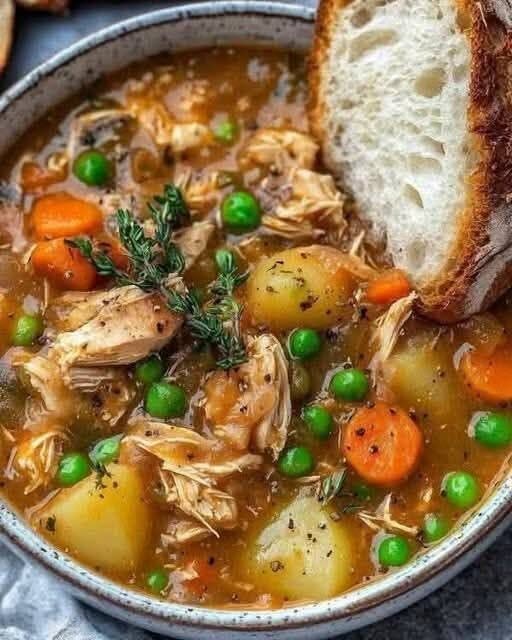
Hearty Chicken & Vegetable Stew
A Nourishing, Protein-Rich One-Pot Chicken Stew for a Balanced Meal
This Hearty Chicken and Vegetable Stew is a comforting, homemade meal filled with tender chicken, potatoes, carrots, peas, onions, garlic, and fragrant herbs in a rich savory broth. It is inspired by the stew shown in your photo, with a lighter preparation that focuses on vegetables, lean protein, and a flavorful broth rather than a heavy cream-based sauce.
For a balanced eating pattern, you do not need to completely eliminate potatoes, bread, or other carbohydrates. Instead, this recipe uses measured portions and plenty of vegetables alongside chicken. The result is a filling meal that can work beautifully as part of an overall nutritious routine.
The stew is especially good on chilly evenings when you want something warm and satisfying. Everything cooks together in one pot, allowing the vegetables and chicken to flavor the broth while the herbs add a delicious homemade aroma.
This recipe is also naturally adaptable. You can change the vegetables according to what you have available, use boneless chicken breast or thigh meat, and adjust the consistency from a brothy soup to a thicker traditional stew.
Important note: No individual recipe causes weight loss on its own. This version is designed as a portion-conscious, vegetable-rich and protein-rich meal that can fit into a balanced eating pattern.
Recipe Overview
Recipe Name: Hearty Chicken & Vegetable Stew
Category: Dinner / Lunch
Cuisine: American-inspired comfort food
Preparation Time: 20 minutes
Cooking Time: 45–55 minutes
Total Time: About 1 hour 10 minutes
Servings: 6
Difficulty: Easy
Cooking Method: One-pot stovetop
Best For: Family dinner, meal prep, cold-weather meals, balanced lunches
Ingredients
For the Chicken Stew
- 1½ pounds (680 g) boneless, skinless chicken breast, cut into bite-sized pieces
- 1 tablespoon (15 ml) olive oil
- 1 medium yellow onion, diced
- 3 cloves garlic, minced
- 4 medium carrots, peeled and sliced
- 2 medium celery stalks, sliced
- 1 pound (450 g) baby potatoes, halved or quartered
- 1 cup (150 g) frozen green peas
- 6 cups (1.4 liters) low-sodium chicken broth
- 1 tablespoon tomato paste
- 1 teaspoon dried thyme
- 1 teaspoon dried parsley
- ½ teaspoon dried rosemary
- 1 bay leaf
- ½ teaspoon paprika
- ½ teaspoon black pepper
- ½ teaspoon salt, or to taste
- 1 tablespoon fresh lemon juice
- 2 tablespoons fresh parsley, chopped
For Thickening
- 2 tablespoons (16 g) all-purpose flour
- 3 tablespoons cold water
Optional
- ½ teaspoon red pepper flakes
- ½ teaspoon garlic powder
- Fresh thyme for garnish
- Extra black pepper
- Lemon wedges
Why This Recipe Works
The beauty of this stew comes from the combination of lean chicken, colorful vegetables, potatoes, peas, and aromatic herbs. Instead of depending on cream, butter, or a large amount of oil for richness, the recipe develops flavor through browning the chicken and vegetables and slowly simmering everything in broth.
Chicken breast provides a substantial source of protein, while carrots, celery, peas, onions, and potatoes contribute different textures and flavors. The potatoes also help make the stew satisfying without requiring a separate large side dish.
The small amount of tomato paste adds depth and color. It may seem like a minor ingredient, but cooking it briefly with the vegetables helps bring out its savory character.
Fresh lemon juice is added near the end. This is a simple professional cooking trick: a little acidity can brighten a slow-cooked dish and balance the savory flavors.
Step-by-Step Instructions
1. Prepare the Chicken
Pat the chicken dry with paper towels.
Cut it into approximately 1-inch pieces so that the pieces cook evenly.
Place the chicken in a bowl and season with paprika, black pepper, and a small amount of salt.
Cutting the chicken into similar-sized pieces is important because very small pieces can become dry before larger pieces are fully cooked.
2. Prepare the Vegetables
Dice the onion, slice the carrots and celery, and cut the potatoes into similar-sized pieces.
Mince the garlic.
Keep the peas separate because they will be added later.
Preparing everything before cooking makes this one-pot recipe much easier to manage.
3. Brown the Chicken
Place a large Dutch oven or heavy-bottomed pot over medium-high heat.
Add 1 tablespoon olive oil.
When the oil is warm, add the chicken in a single layer.
Cook for approximately 4–6 minutes, turning occasionally, until the outside develops light golden-brown color.
The chicken does not need to be completely cooked at this stage because it will finish cooking in the stew.
Transfer the chicken to a clean plate.
4. Cook the Onion
Using the same pot, add the diced onion.
Cook for approximately 3 minutes, stirring occasionally.
The onion should become soft and translucent.
The browned bits left on the bottom of the pot will begin to dissolve as the vegetables release moisture.
5. Add Carrots and Celery
Add the sliced carrots and celery.
Cook for approximately 4–5 minutes.
Stir occasionally.
This short sautéing step gives the vegetables a deeper flavor than simply adding everything directly to the broth.
6. Add the Garlic
Add the minced garlic.
Cook for approximately 30–45 seconds.
Stir constantly so the garlic doesn’t burn.
Once it becomes fragrant, immediately continue to the next step.
7. Add Tomato Paste
Add 1 tablespoon tomato paste.
Stir it into the vegetables.
Cook for approximately 1 minute.
This brief cooking period helps develop the flavor of the tomato paste and gives the stew a richer color.
8. Add the Herbs
Add the thyme, parsley, rosemary, black pepper, and bay leaf.
Stir well.
The combination of herbs gives the stew a classic homemade flavor.
If you have fresh thyme available, you can substitute approximately 1 tablespoon fresh thyme leaves for the dried thyme.
9. Add the Chicken Broth
Slowly pour the low-sodium chicken broth into the pot.
Use a wooden spoon to gently scrape the bottom of the pot.
Those browned bits contain concentrated flavor from the chicken and vegetables.
Bring the liquid to a gentle simmer.
10. Add the Potatoes
Add the prepared potatoes.
Stir everything together.
Make sure the potatoes are mostly submerged in the broth.
If necessary, add a little additional broth or water.
11. Return the Chicken
Return the browned chicken and any accumulated juices to the pot.
Stir gently.
Bring the stew back to a gentle simmer.
Avoid a violent boil because a slow simmer helps keep the chicken tender.
12. Simmer the Stew
Cover the pot partially with a lid.
Allow the stew to simmer for approximately 25–30 minutes.
Stir occasionally.
The carrots and potatoes should gradually become tender while the broth takes on the flavor of the chicken and herbs.
13. Check the Chicken
Check a thick piece of chicken with a food thermometer.
Chicken should reach an internal temperature of 165°F (74°C).
Once the chicken reaches the safe temperature and the vegetables are tender, continue to the next step.
14. Add the Peas
Add 1 cup frozen peas during the final 4–5 minutes of cooking.
Frozen peas do not require a long cooking time.
Adding them toward the end helps preserve their bright color and fresh flavor.
How to Thicken the Stew
15. Make the Slurry
If you prefer a thicker stew like the one shown in the photo, combine:
- 2 tablespoons flour
- 3 tablespoons cold water
Whisk until completely smooth.
There should be no visible lumps.
16. Add the Slurry
Slowly pour the flour mixture into the simmering stew while stirring continuously.
Allow the stew to simmer for approximately 3–5 minutes.
The broth should gradually become thicker.
Do not add dry flour directly to the hot stew because it can form unpleasant lumps.
17. Finish with Lemon
Turn the heat to low.
Remove the bay leaf.
Add 1 tablespoon fresh lemon juice.
Stir gently.
Taste the broth.
The lemon should not make the stew taste strongly sour. Its purpose is simply to brighten the flavors.
18. Adjust the Seasoning
Taste the finished stew.
Add additional black pepper if desired.
If the broth needs more salt, add a small amount gradually.
Using low-sodium broth gives you more control over the final salt level.
19. Add Fresh Parsley
Stir in 2 tablespoons freshly chopped parsley.
Reserve a little parsley for garnishing individual bowls.
Fresh herbs added at the end give the stew a much fresher aroma.
20. Let the Stew Rest
Turn off the heat and allow the stew to rest for approximately 5 minutes.
This gives the flavors time to settle and allows the broth to thicken slightly.
21. Serve
Ladle the hot stew into six bowls.
Garnish with fresh parsley and a little freshly cracked black pepper.
A lemon wedge can be served on the side for anyone who wants additional brightness.
How to Make This Recipe More Balanced
This stew is already built around several nutritious food groups.
Chicken provides protein, while vegetables add color and variety. Potatoes and peas contribute carbohydrates that can provide energy and make the meal more satisfying.
Rather than removing potatoes completely, this recipe uses a measured amount and combines them with a generous quantity of vegetables.
For a balanced plate, you can serve one portion of stew with a side salad or additional steamed vegetables.
There is also no need to serve a large amount of bread alongside the stew because the potatoes already provide a starchy component.
If You Want a Lighter Broth
You can completely skip the flour slurry.
The potatoes will naturally release some starch as they cook, which gives the broth a little body.
For an even lighter preparation, use ½ pound (225 g) potatoes and increase the carrots, celery, mushrooms, or green beans.
This creates a vegetable-forward stew while maintaining the chicken and broth as the foundation.
How to Add More Vegetables
This recipe is extremely flexible.
You can add:
- Mushrooms
- Green beans
- Zucchini
- Spinach
- Cabbage
- Bell peppers
- Corn
- Cauliflower
- Broccoli
If using delicate vegetables such as spinach or zucchini, add them toward the end so they don’t become excessively soft.
How to Make It Creamy
If you prefer a creamy chicken stew, don’t automatically add heavy cream.
Instead, remove approximately 1 cup of the cooked stew, blend it carefully, and return it to the pot.
The potatoes and vegetables will naturally thicken the broth.
You can also stir in ¼ cup plain Greek yogurt after removing the pot from direct heat, but avoid boiling after adding yogurt because it can separate.
How to Make It in a Slow Cooker
You can adapt this recipe for a slow cooker.
Brown the chicken and vegetables first if you have time, then transfer them to the slow cooker.
Add the broth, potatoes, tomato paste, herbs, and seasonings.
Cook on LOW for approximately 5–6 hours or until the chicken and vegetables are thoroughly cooked.
Add the peas during the final 20–30 minutes.
If thickening is desired, use a flour or cornstarch slurry near the end.
Always confirm that the chicken reaches 165°F (74°C).
How to Make It in an Instant Pot
For pressure cooking, sauté the chicken and vegetables first.
Add the broth, potatoes, tomato paste, and herbs.
Secure the lid and cook according to your pressure cooker’s instructions for chicken stew.
Allow appropriate pressure release according to the appliance’s instructions.
Add the peas after pressure cooking and use the sauté function briefly if needed.
Because pressure cookers vary, follow the manufacturer’s safety instructions.
Meal Prep Instructions
This stew is excellent for meal preparation because the flavor often becomes even better after sitting overnight.
Divide the cooled stew into individual airtight containers.
Store it in the refrigerator and reheat individual portions when needed.
You can prepare the full batch on the weekend and have several convenient lunches or dinners ready.
For portion consistency, divide the entire recipe into six approximately equal portions rather than serving directly from the pot each time.
Storage
Refrigerate leftovers promptly in shallow airtight containers.
For best quality, use refrigerated leftovers within 3–4 days.
Keep the refrigerator at 40°F (4°C) or below.
If you are unsure how long the stew has been sitting out, it is safer not to consume it.
Freezing Instructions
Chicken stew freezes well.
Allow the stew to cool appropriately before transferring it to freezer-safe containers.
Leave a little space at the top because liquid expands when frozen.
Label the container with the date.
Thaw overnight in the refrigerator and reheat thoroughly.
The potatoes may become slightly softer after freezing, but the stew will still be delicious.
Reheating Instructions
Reheat the stew gently on the stovetop over medium-low heat.
Stir occasionally.
If the stew has thickened significantly in the refrigerator, add a small amount of chicken broth or water.
You can also reheat individual portions in the microwave.
Heat until the center is thoroughly hot, stirring partway through.
What to Serve with Chicken Stew
Because this stew contains chicken, vegetables, peas, and potatoes, it can stand alone as a complete meal.
If you want additional vegetables, serve it with:
- Green salad
- Steamed broccoli
- Roasted green beans
- Simple cucumber salad
- Steamed cabbage
If serving bread, choose a modest portion of whole-grain or crusty bread.
The bread shown in the photograph makes a delicious accompaniment, but it is optional.
Recipe Variations
Lemon Herb Chicken Stew
Increase the lemon juice and add extra fresh parsley and thyme.
Mediterranean Chicken Stew
Add diced tomatoes, oregano, zucchini, and a small amount of olives.
Spicy Chicken Vegetable Stew
Add paprika, chili flakes, and a pinch of cayenne.
Mushroom Chicken Stew
Add 8 ounces of sliced mushrooms with the carrots and celery.
Green Bean Chicken Stew
Replace some of the peas with fresh or frozen green beans.
Rustic Root Vegetable Stew
Replace some potatoes with turnips, parsnips, or sweet potato.
Common Mistakes to Avoid
Don’t Overcook the Chicken
Chicken breast is lean and can become dry when simmered for too long.
Don’t Cut Vegetables Unevenly
Very large potato pieces may remain hard while smaller pieces become soft.
Don’t Boil Aggressively
A gentle simmer is better for maintaining a tender texture.
Don’t Add Peas Too Early
Frozen peas cook quickly and can lose their color if simmered for a long time.
Don’t Add Flour Directly
Always mix flour with cold water first to create a smooth slurry.
Don’t Over-Salt
Low-sodium broth allows you to control the seasoning more easily.
Don’t Skip the Final Acid
A little lemon juice can make a big difference in a rich savory stew.
Approximate Nutrition
The following estimates are based on 6 servings and include the chicken, vegetables, potatoes, broth, olive oil, flour, and other listed ingredients.
| Nutrient | Approx. Per Serving |
|---|---|
| Calories | 350–390 kcal |
| Protein | 38–43 g |
| Carbohydrates | 35–42 g |
| Fat | 8–11 g |
| Fiber | 6–8 g |
| Sugar | 7–9 g |
| Sodium | 550–750 mg |
| Calcium | 60–100 mg |
| Iron | 2–3 mg |
Nutrition disclaimer: These figures are estimates, not laboratory-tested values. Actual nutrition varies depending on the brands of broth, chicken, flour, vegetables, and other ingredients used. For a website nutrition panel, calculate the recipe using the exact products and quantities in your final recipe.
Frequently Asked Questions
Can I use chicken thighs instead of chicken breast?
Yes. Boneless, skinless chicken thighs work very well and have a richer flavor. The nutrition information will change slightly.
Can I use frozen vegetables?
Absolutely. Frozen peas are already used in this recipe, and frozen carrots, green beans, or mixed vegetables can also work.
Can I make this gluten-free?
Yes. Omit the flour slurry or replace the flour with a certified gluten-free thickener such as cornstarch. Also verify that your broth and other packaged ingredients are gluten-free.
Can I leave out the potatoes?
Yes. You can replace them with additional vegetables such as cauliflower, zucchini, mushrooms, or green beans.
Can I use sweet potatoes?
Yes. Sweet potatoes give the stew a slightly sweeter flavor and beautiful color.
Can I make this dairy-free?
Yes. The basic recipe is already dairy-free as written unless you add optional yogurt or other dairy ingredients.
Can I make it vegetarian?
Yes, although you would need to replace the chicken with beans, lentils, chickpeas, tofu, or another vegetarian protein and use vegetable broth.
Why is my stew too thin?
Allow it to simmer uncovered for several additional minutes, or add a properly mixed slurry.
Why is my stew too thick?
Add a little chicken broth or water and stir over low heat.
Can I add noodles?
Yes, but add them toward the end because noodles can absorb a significant amount of broth.
Can I add rice?
Yes. Cooked rice can be stirred in near the end. Keep in mind that rice will continue absorbing broth as the stew sits.
Complete Recipe Card
Hearty Chicken & Vegetable Stew
Yield: 6 servings
Prep: 20 minutes
Cook: 45–55 minutes
Total: About 1 hour 10 minutes
Ingredients
- 1½ lb (680 g) boneless, skinless chicken breast
- 1 tbsp olive oil
- 1 onion
- 3 garlic cloves
- 4 carrots
- 2 celery stalks
- 1 lb (450 g) baby potatoes
- 1 cup frozen peas
- 6 cups low-sodium chicken broth
- 1 tbsp tomato paste
- 1 tsp dried thyme
- 1 tsp dried parsley
- ½ tsp rosemary
- 1 bay leaf
- ½ tsp paprika
- ½ tsp black pepper
- ½ tsp salt
- 1 tbsp lemon juice
- 2 tbsp fresh parsley
For thickening:
- 2 tbsp flour
- 3 tbsp cold water
Instructions
- Cut chicken into bite-sized pieces.
- Season with paprika, pepper, and salt.
- Heat olive oil in a large pot.
- Brown chicken for 4–6 minutes.
- Transfer chicken to a plate.
- Add onion and cook for 3 minutes.
- Add carrots and celery.
- Cook for 4–5 minutes.
- Add garlic and cook for 30–45 seconds.
- Stir in tomato paste.
- Add thyme, parsley, rosemary, bay leaf, and remaining seasoning.
- Pour in chicken broth.
- Add potatoes.
- Return chicken to the pot.
- Bring to a gentle simmer.
- Cover partially and cook for 25–30 minutes.
- Add frozen peas during the final 4–5 minutes.
- Mix flour and cold water in a bowl.
- Stir the slurry into the stew.
- Simmer for 3–5 minutes until thickened.
- Remove bay leaf.
- Add lemon juice.
- Stir in fresh parsley.
- Taste and adjust seasoning.
- Rest for 5 minutes.
- Serve warm.