

Ingredients
For the Chocolate Cake
- All-purpose flour
- Granulated sugar
- Unsweetened cocoa powder
- Baking soda
- Baking powder
- Salt
- Large eggs
- Buttermilk
- Vegetable oil
- Pure vanilla extract
- Hot brewed coffee
For the Coconut-Pecan Frosting
- Evaporated milk
- Granulated sugar
- Egg yolks
- Unsalted butter
- Pure vanilla extract
- Sweetened shredded coconut
- Pecans
For Decoration
- Whole pecan halves
- Shredded coconut
- Chocolate shavings, optional
Directions
1. Prepare the Oven and Cake Pans
Begin by preheating your oven to 350°F (175°C). Allow the oven to fully reach temperature before placing the cake inside, because an oven that is still heating can affect how evenly the layers rise.
Prepare three 8-inch round cake pans. Grease the bottom and sides thoroughly with butter, shortening, or nonstick baking spray. Place a round piece of parchment paper in the bottom of each pan, then lightly grease the parchment as well.
The parchment is especially helpful with chocolate cake because it prevents the delicate layers from sticking when they are removed from the pans. If you only have two pans, you can bake the layers in batches.
2. Prepare the Dry Ingredients
Take a large mixing bowl and add the all-purpose flour, granulated sugar, unsweetened cocoa powder, baking soda, baking powder, and salt.
Whisk the ingredients together thoroughly until the cocoa is evenly distributed throughout the flour mixture. Breaking up any cocoa lumps at this stage will help create a smoother cake batter later.
For an especially light and even cake texture, sift the flour and cocoa powder before combining them with the remaining dry ingredients.
3. Prepare the Wet Ingredients
In a separate large bowl, combine the eggs, buttermilk, vegetable oil, and vanilla extract.
Whisk everything together until the eggs are completely incorporated and the mixture looks smooth and uniform. Using ingredients that are close to room temperature will help them blend more easily.
The buttermilk contributes moisture and tenderness to the cake, while the oil helps keep the finished cake soft even after refrigeration.
4. Combine the Wet and Dry Mixtures
Slowly pour the wet ingredients into the bowl containing the dry ingredients.
Using a whisk or large spatula, gently stir the mixture until everything is combined. Do not vigorously beat the batter or continue mixing longer than necessary.
At this point, the batter may look somewhat thick. That is completely normal because the hot coffee will be added next.
5. Add the Hot Coffee
Slowly pour the hot brewed coffee into the cake batter while stirring continuously.
The batter will become noticeably thinner. Do not be concerned if it looks much more liquid than traditional cake batter. This thin consistency is one of the reasons the finished cake develops such a moist and tender crumb.
The coffee does not make the cake taste strongly like coffee. Instead, it enhances the natural flavor of the cocoa and gives the chocolate a deeper, richer character.
If you do not want to use coffee, you can substitute an equal amount of hot water.
6. Divide the Batter
Pour the prepared batter evenly into the three greased and parchment-lined cake pans.
For the most professional result, divide the batter by weight using a kitchen scale. Equal amounts of batter will produce layers of approximately the same thickness, making the finished cake easier to assemble.
Gently tap each pan against the countertop once or twice to release any large air bubbles. Do not repeatedly bang the pans, as this can unnecessarily disturb the batter.
7. Bake the Chocolate Cake
Place the cake pans in the preheated oven and bake for approximately 25–30 minutes.
The exact baking time can vary depending on your oven, cake pans, and the amount of batter in each pan. Begin checking the layers around the 23-minute mark.
Insert a toothpick into the center of each cake. The cakes are ready when the toothpick comes out clean or with a few moist crumbs attached. Do not wait until the toothpick is completely dry, because overbaking can make the cake less moist.
The center should also spring back gently when touched with a fingertip.
8. Cool the Cake Layers
Remove the baked cakes from the oven and place the pans on wire cooling racks.
Allow the layers to cool inside the pans for approximately 10–15 minutes. Do not immediately remove them while they are extremely hot because the layers can be fragile and may break.
After the initial cooling period, carefully run a thin knife around the edges if necessary. Turn each cake layer onto a wire rack and gently remove the parchment paper.
Allow the layers to cool completely before assembling the cake.
9. Toast the Pecans
While the cake layers are cooling, prepare the pecans for the frosting.
Spread the chopped pecans evenly on a baking sheet. Place them in a 350°F (175°C) oven for approximately 6–8 minutes, stirring once halfway through.
Keep a close eye on them because pecans can burn quickly. Remove them from the oven as soon as they become fragrant and lightly toasted.
Allow the pecans to cool before adding them to the frosting. Toasting is optional, but it adds considerably more flavor and gives the finished cake a pleasant nutty aroma.
10. Begin the Coconut-Pecan Frosting
Place the evaporated milk, granulated sugar, egg yolks, and unsalted butter into a medium-sized heavy-bottomed saucepan.
Place the saucepan over medium-low heat. Stir the mixture frequently with a heat-resistant spatula or wooden spoon.
The butter will gradually melt while the sugar dissolves into the milk. Continue stirring so that the mixture does not stick to the bottom or sides of the pan.
11. Cook the Frosting Slowly
Continue cooking the mixture gently until it becomes noticeably thicker.
This process generally takes approximately 8–12 minutes, although the exact timing can vary. The mixture should become creamy and thick enough to coat the back of a spoon.
Avoid using very high heat. Cooking the frosting too aggressively can cause the egg yolks to cook too quickly, resulting in small pieces of scrambled egg and an uneven texture.
Patience is important during this stage. Slow and gentle cooking produces a much smoother frosting.
12. Check the Frosting Consistency
To test the frosting, dip a spoon or spatula into the mixture and lift it out. The mixture should cling to the utensil rather than immediately running off like milk.
Remember that the frosting will continue to thicken as it cools, so it does not need to be extremely thick while it is still on the stove.
Once the proper consistency is reached, immediately remove the saucepan from the heat.
13. Add the Vanilla, Coconut, and Pecans
Stir the vanilla extract into the warm frosting.
Next, add the shredded coconut and toasted chopped pecans. Stir thoroughly until the coconut and pecans are evenly distributed throughout the mixture.
Every spoonful of frosting should contain a good combination of coconut and pecans. If necessary, scrape the bottom and sides of the saucepan while stirring to make sure everything is evenly incorporated.
14. Cool the Frosting
Transfer the warm frosting to a clean heat-resistant bowl.
Allow it to cool at room temperature, stirring occasionally. As it cools, the butter will firm slightly and the mixture will become thicker and easier to spread.
Do not try to frost the cake while the frosting is extremely hot. Hot frosting can soften the chocolate cake and may slide between the layers.
The ideal consistency is thick, creamy, and spreadable.
15. Prepare the Cake Layers for Assembly
Once the cake layers are completely cool, inspect the tops.
If the layers have developed a noticeable dome, carefully level them with a long serrated knife. Slice away only the raised portion, keeping as much cake as possible.
Leveling the layers is optional, but it creates a more stable and professional-looking cake.
If the layers are already flat, you can skip this step.
16. Assemble the First Layer
Place the first chocolate cake layer on a cake board, serving plate, or cake stand.
Spoon a generous amount of coconut-pecan frosting over the top of the layer. Using an offset spatula, spread the frosting evenly from the center toward the edges.
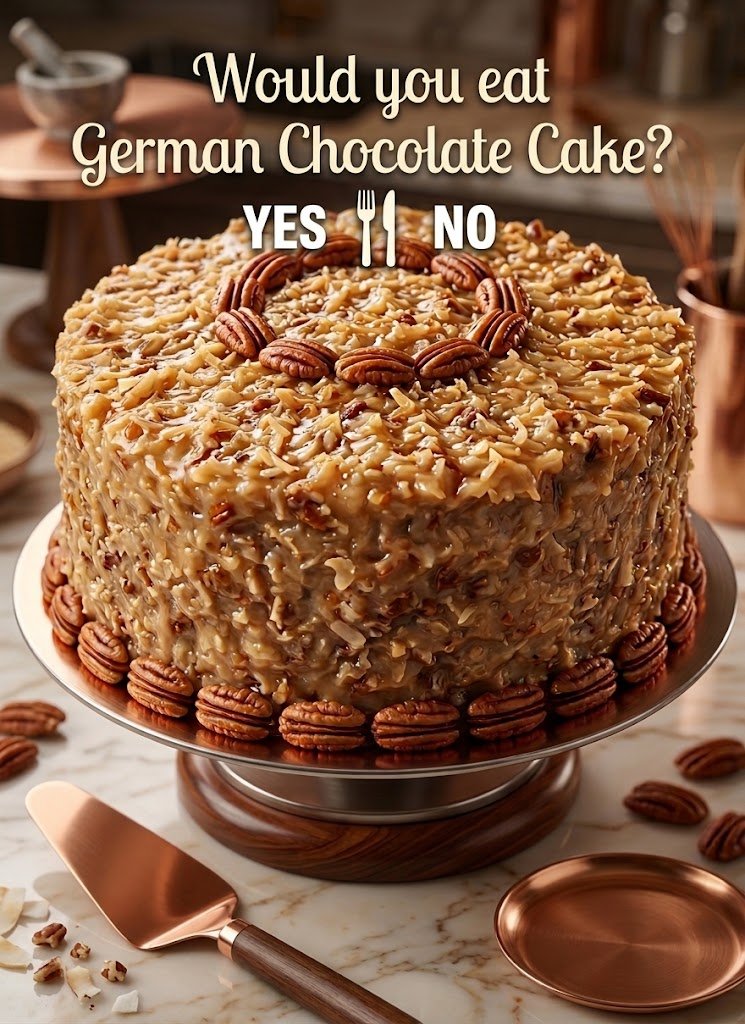
Do not worry about making the frosting perfectly smooth. Traditional German Chocolate Cake has a rustic appearance, and the visible coconut and pecans are part of its appeal.
17. Add the Second Cake Layer
Carefully place the second chocolate cake layer over the first frosted layer.
Gently press it down just enough to secure it, but avoid pressing too firmly because too much pressure can force the frosting out from between the layers.
Check the sides of the cake to make sure the layers are centered. If necessary, gently adjust the second layer before adding more frosting.
18. Add More Coconut-Pecan Frosting
Spread another generous layer of coconut-pecan frosting over the second cake layer.
Try to distribute the frosting evenly so that the finished cake has a consistent amount of filling from one side to the other.
The frosting should be thick enough to create a noticeable layer between the chocolate cakes without being so thick that the cake becomes difficult to stack.
19. Add the Final Cake Layer
Place the final chocolate cake layer on top.
Position it carefully so that all three layers are aligned. If you leveled the cake layers earlier, the top should now sit relatively flat.
Use the remaining coconut-pecan frosting to cover the top of the cake and, if desired, the sides as well.
20. Frost the Sides
Traditional German Chocolate Cake can be finished with frosting covering the entire cake, including the sides.
Use an offset spatula to spread the coconut-pecan frosting around the sides. Work gently because the coconut and pecans can catch on the cake surface.
A completely smooth finish is not necessary. A textured, rustic finish actually makes the cake look homemade and highlights the generous coconut-pecan topping.
If you prefer a more classic presentation, leave the chocolate cake layers partially visible around the sides and concentrate most of the frosting on the top and between the layers.
21. Decorate the Top
For a beautiful presentation, arrange whole toasted pecan halves around the top of the cake.
You can place them in a circular pattern around the center, arrange them around the outer edge, or simply scatter them naturally over the frosting.
For an additional chocolate finish, add a small amount of chocolate shavings or curls.
Avoid adding too many decorations because the coconut-pecan frosting should remain the main feature of the cake.
22. Allow the Cake to Set
Once the cake is completely assembled, allow it to rest for at least 30–60 minutes before slicing.
This resting period gives the frosting time to settle into the layers and helps the cake become more stable.
For especially neat slices, refrigerate the cake for approximately one hour before serving. Chilling makes the layers and frosting easier to cut cleanly.
23. Bring the Cake to Serving Temperature
If the cake has been refrigerated, remove it approximately 20–30 minutes before serving.
Allowing the cake to sit at room temperature softens the frosting and improves the texture of the chocolate cake.
Serving it too cold can make the cake seem firmer and reduce some of the flavor. A slightly cool or room-temperature slice provides a much better texture.
24. Slice and Serve
Use a sharp serrated knife to cut the cake into portions.
For clean slices, wipe the knife with a warm, slightly damp cloth between cuts. This prevents frosting and cake crumbs from building up on the blade.
Serve each slice with plenty of coconut-pecan frosting. The ideal bite should include soft chocolate cake, creamy frosting, chewy coconut, and crunchy pecans.
25. Storage
Store leftover cake in an airtight cake container or cover it tightly with plastic wrap.
Because the frosting contains evaporated milk and egg yolks, refrigeration is recommended for longer storage.
The cake can generally be refrigerated for approximately 3–4 days when properly covered. Allow individual slices to sit at room temperature briefly before serving for the best texture.
26. Freezing Instructions
You can also freeze leftover slices for longer storage.
Wrap each slice tightly in plastic wrap, then place the wrapped slices in a freezer-safe container or freezer bag. Label the container with the date so you can easily keep track of storage time.
When ready to eat, thaw the cake in the refrigerator and then allow it to sit at room temperature before serving.
27. Important Tips for the Best Cake
Use good-quality cocoa powder for the best chocolate flavor. Since chocolate is one of the main flavors in this dessert, the quality of the cocoa can make a noticeable difference.
Do not overmix the batter after adding the flour. Mix only until the ingredients are incorporated.
Do not overbake the cake layers. A few moist crumbs on the toothpick are preferable to a completely dry toothpick.
Allow both the cake and frosting to cool properly before assembly. This is one of the most important steps for achieving a stable, attractive layer cake.
Toast the pecans before adding them to the frosting whenever possible. The additional roasting step takes only a few minutes but gives the nuts significantly more flavor.
28. Tips for Perfect Coconut-Pecan Frosting
The frosting should be cooked slowly over medium-low heat. High heat can cause the egg yolks to curdle and may make the frosting grainy.
Stir frequently while the frosting is cooking, paying particular attention to the bottom and corners of the saucepan.
If the frosting seems too thin immediately after cooking, do not add extra coconut or flour right away. Let it cool first because the mixture naturally thickens as it reaches room temperature.
If the frosting becomes too thick, allow it to warm slightly and stir it thoroughly. A very small amount of evaporated milk can be added if necessary.
29. Make-Ahead Preparation
This cake is excellent for preparing ahead of time.
The chocolate cake layers can be baked the day before assembly. Once completely cool, wrap them tightly and keep them refrigerated until you are ready to assemble the cake.
The coconut-pecan frosting can also be prepared ahead of time. Store it in a covered container in the refrigerator, then bring it toward room temperature and stir it thoroughly before using.
For holidays and celebrations, assembling the cake the day before serving can make entertaining much easier. The resting time also allows the flavors to blend beautifully.
30. Serving Suggestions
German Chocolate Cake is rich enough to serve by itself, but it also pairs beautifully with vanilla ice cream.
A small amount of lightly sweetened whipped cream can provide a soft, airy contrast to the dense coconut-pecan frosting.
For a special occasion, serve the cake with fresh berries. Strawberries, raspberries, or blueberries provide a refreshing contrast to the rich chocolate and sweet frosting.
Coffee or espresso is another excellent accompaniment because its slightly bitter flavor balances the sweetness of the cake.
Recipe Notes
The key to an excellent German Chocolate Cake is balance. The chocolate cake should be moist and flavorful without being excessively sweet, while the coconut-pecan frosting should be rich, buttery, nutty, and pleasantly chewy.
For the closest result to the cake shown in the image, use three round layers and spread the coconut-pecan frosting generously over the top and sides. Finish with toasted pecan halves arranged decoratively around the center.
This cake is particularly well suited to birthdays, holidays, family gatherings, potlucks, anniversaries, dinner parties, and weekend baking. It has an impressive appearance but can be prepared with straightforward ingredients and traditional baking techniques.
The finished cake should have soft chocolate layers that hold together easily when sliced, with generous layers of creamy coconut and pecan frosting between them. Allowing the cake to rest before serving helps the frosting settle and makes each slice more cohesive.
Final Result
When prepared correctly, this German Chocolate Cake has everything you want from a classic homemade layer cake: tender chocolate layers, rich coconut-pecan frosting, buttery toasted nuts, chewy coconut, and a beautiful rustic finish.
The combination of textures is what makes this dessert so memorable. The chocolate cake is soft and moist, the frosting is creamy and slightly caramel-like, the coconut provides chewiness, and the pecans contribute a satisfying crunch.
For the best overall flavor, serve the cake slightly cool or at room temperature rather than directly from the refrigerator. This allows the chocolate, butter, coconut, and pecan flavors to become more pronounced.
This classic recipe is a wonderful choice when you want a dessert that looks impressive on the table while still delivering the comforting, homemade flavor of a traditional family cake.