
🥕 Ultimate Roasted Fall Vegetable Platter
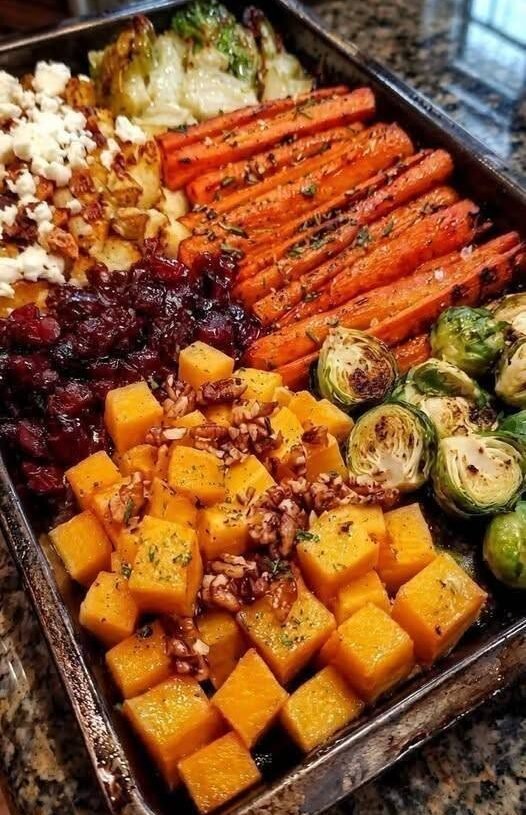
Caramelized carrots, tender butternut squash, crispy Brussels sprouts, roasted cauliflower, toasted pecans, dried cranberries, and creamy feta with a maple-herb glaze
This colorful Roasted Fall Vegetable Platter is a beautiful side dish for Thanksgiving, Christmas, Sunday dinner, family gatherings, or any meal where you want vegetables to feel special. The vegetables are roasted at high heat until their edges become beautifully browned and caramelized, then finished with tangy feta, toasted pecans, dried cranberries, fresh herbs, and a sweet-tangy maple balsamic dressing.
The photograph shows several vegetables arranged separately rather than completely mixed together, which makes the finished platter especially attractive. Keeping the vegetables in sections also allows each ingredient to retain its own texture and flavor.
High-heat roasting is particularly effective for vegetables because giving them enough space on the pan encourages browning instead of steaming. (Serious Eats)
🌟 Why You’ll Love This Recipe
This isn’t just another tray of roasted vegetables. The combination of sweet, savory, tangy, crunchy, and creamy ingredients makes it feel like a complete centerpiece side dish.
The butternut squash becomes tender and naturally sweet as it roasts.
The carrots develop browned edges while remaining pleasantly tender in the center.
The Brussels sprouts become deeply caramelized, particularly on their cut sides.
The cauliflower develops roasted edges and a slightly nutty flavor.
Then come the toppings: feta cheese, pecans, dried cranberries, and fresh herbs add completely different textures to the roasted vegetables.
Finally, a light maple-balsamic glaze ties everything together with sweetness and acidity.
Similar roasted vegetable platters commonly pair carrots, squash, Brussels sprouts, feta, nuts, dried fruit, and a maple-balsamic style finishing sauce. (sipthesoup.com)
🥕 Recipe Details
Recipe Name: Ultimate Roasted Fall Vegetable Platter
Category: Side Dish
Cuisine: American-inspired
Preparation Time: 30 minutes
Roasting Time: 35–45 minutes
Total Time: About 1 hour 15 minutes
Servings: 8–10
Difficulty: Easy to moderate
🛒 Ingredients
For the Roasted Vegetables
Carrots
- 1½ pounds (680 g) medium carrots
- 1 tablespoon olive oil
- ½ teaspoon kosher salt
- ¼ teaspoon black pepper
- ½ teaspoon dried thyme
- ½ teaspoon garlic powder
Butternut Squash
- 1½ pounds (680 g) peeled butternut squash
- 1½ tablespoons olive oil
- ½ teaspoon salt
- ¼ teaspoon black pepper
- ½ teaspoon dried sage
- ½ teaspoon garlic powder
- ¼ teaspoon ground cinnamon
Brussels Sprouts
- 1 pound (450 g) Brussels sprouts
- 1½ tablespoons olive oil
- ½ teaspoon salt
- ¼ teaspoon black pepper
- ½ teaspoon garlic powder
- ½ teaspoon dried thyme
Cauliflower
- 1 medium head cauliflower, about 1½ pounds
- 1½ tablespoons olive oil
- ½ teaspoon salt
- ¼ teaspoon black pepper
- ½ teaspoon smoked paprika
- ½ teaspoon dried oregano
🍁 Maple-Balsamic Glaze
- 3 tablespoons pure maple syrup
- 2 tablespoons balsamic vinegar
- 1 tablespoon Dijon mustard
- 1 tablespoon olive oil
- 1 small garlic clove, finely minced
- ¼ teaspoon black pepper
- Pinch of salt
🧀 For the Toppings
- ¾ cup crumbled feta cheese
- ½ cup pecans, roughly chopped
- ½ cup dried cranberries
- 2 tablespoons fresh parsley, chopped
- 1 tablespoon fresh thyme leaves
- 1–2 tablespoons pomegranate seeds, optional
- 1 tablespoon finely chopped fresh rosemary, optional
- 1 teaspoon orange zest, optional
👩🍳 How to Make the Roasted Vegetable Platter
1. Preheat the Oven
Preheat your oven to 425°F (220°C).
Use two large rimmed baking sheets if possible. The vegetables need enough room to spread into a single layer.
Overcrowding the pan can cause vegetables to release steam instead of developing browned, roasted edges. (Serious Eats)
2. Prepare the Carrots
Wash and peel the carrots.
Cut them lengthwise into halves or quarters depending on their size.
The goal is to create pieces that are reasonably similar in thickness so they finish cooking at approximately the same time.
Place the carrots into a large bowl.
Add:
- 1 tablespoon olive oil
- ½ teaspoon salt
- ¼ teaspoon black pepper
- ½ teaspoon thyme
- ½ teaspoon garlic powder
Toss thoroughly until every carrot is lightly coated.
3. Prepare the Butternut Squash
Peel the butternut squash if necessary.
Remove the seeds and cut the flesh into approximately 1-inch cubes.
Try to keep the cubes relatively similar in size.
Place them in a separate bowl and add:
- 1½ tablespoons olive oil
- ½ teaspoon salt
- ¼ teaspoon black pepper
- ½ teaspoon sage
- ½ teaspoon garlic powder
- ¼ teaspoon cinnamon
Toss gently.
The tiny amount of cinnamon doesn’t make the squash taste like dessert. Instead, it complements the natural sweetness of the roasted squash.
4. Prepare the Brussels Sprouts
Trim away the tough bottom ends.
Cut each Brussels sprout in half through the stem.
If some sprouts are especially large, cut them into quarters.
Place them into a bowl and toss with:
- 1½ tablespoons olive oil
- ½ teaspoon salt
- ¼ teaspoon black pepper
- ½ teaspoon garlic powder
- ½ teaspoon thyme
Make sure the cut sides receive some of the oil and seasoning.
5. Prepare the Cauliflower
Cut the cauliflower into medium-sized florets.
Try not to make the florets too small because they can brown too quickly.
Add:
- 1½ tablespoons olive oil
- ½ teaspoon salt
- ¼ teaspoon black pepper
- ½ teaspoon smoked paprika
- ½ teaspoon oregano
Toss until evenly coated.
🔥 Roasting the Vegetables
6. Arrange the Carrots
Place the seasoned carrots onto one side of a large baking sheet.
Arrange them in a single layer.
Avoid piling them on top of each other.
7. Add the Butternut Squash
Place the squash on the other side of the baking sheet.
If the tray feels crowded, use another baking sheet rather than forcing everything together.
This extra space can make a noticeable difference in browning.
8. Start Roasting
Place the carrots and squash into the oven.
Roast for approximately 15 minutes.
Don’t immediately stir them.
Allowing vegetables to remain in contact with the hot baking surface helps develop caramelized surfaces. (Serious Eats)
9. Add the Brussels Sprouts and Cauliflower
After the first 15 minutes, carefully remove the tray.
Add the Brussels sprouts and cauliflower.
Place the Brussels sprouts with their cut sides facing downward whenever possible.
This gives the cut surfaces direct contact with the hot pan and encourages beautiful browning.
10. Continue Roasting
Return the tray to the oven.
Continue roasting for another 20–25 minutes.
The total cooking time will usually be around 35–40 minutes, although larger vegetable pieces may require additional time.
A similar Brussels sprout and butternut squash preparation uses 425°F roasting and cooks until the vegetables are tender and browned. (Skinnytaste)
11. Check the Vegetables
The vegetables are ready when:
- Carrots are fork-tender.
- Squash is tender in the center.
- Brussels sprouts have browned edges.
- Cauliflower has golden roasted spots.
- The vegetables have developed caramelized edges.
If necessary, roast for another 5–10 minutes.
🍁 Make the Maple-Balsamic Glaze
12. Combine the Ingredients
While the vegetables roast, add the following to a small saucepan:
- 3 tablespoons maple syrup
- 2 tablespoons balsamic vinegar
- 1 tablespoon Dijon mustard
- 1 tablespoon olive oil
- 1 minced garlic clove
- ¼ teaspoon black pepper
- Pinch of salt
13. Warm the Glaze
Place the saucepan over medium-low heat.
Whisk continuously.
Warm for approximately 2–4 minutes.
You don’t need to boil it aggressively.
The goal is simply to combine the ingredients and slightly thicken the glaze.
14. Taste and Adjust
Taste the glaze carefully.
If it seems too sweet, add another teaspoon of balsamic vinegar.
If it seems too sharp, add a little additional maple syrup.
If you want more savory flavor, add another small amount of Dijon mustard.
Set aside.
🌰 Toast the Pecans
15. Prepare the Nuts
Place the chopped pecans in a dry skillet.
Cook over medium-low heat for approximately 3–5 minutes, stirring frequently.
They should become fragrant and lightly toasted.
Don’t leave them unattended because nuts can burn quickly.
Remove them from the heat immediately once toasted.
🧀 Prepare the Garnishes
16. Crumble the Feta
Place the feta into a small bowl.
If you have a large block of feta, crumble it into small pieces with your fingers or a fork.
Small crumbles distribute better across the vegetables.
17. Prepare the Herbs
Finely chop the parsley.
Remove the thyme leaves from their stems.
If using rosemary, chop it very finely because its flavor is strong.
🍽️ Assemble the Platter
18. Choose a Large Serving Platter
Use a large oval, rectangular, or round serving platter.
For a presentation similar to the photograph, don’t immediately mix all the vegetables together.
Instead, create separate sections.
19. Arrange the Carrots
Place the roasted carrots in one long section.
Arrange them in the same direction for a more polished presentation.
20. Add the Butternut Squash
Place the roasted squash in another section.
Keep the cubes loosely arranged so their golden edges remain visible.
21. Add the Brussels Sprouts
Arrange the Brussels sprouts beside the carrots.
Try to position several sprouts with their caramelized cut sides facing upward.
22. Add the Cauliflower
Arrange the roasted cauliflower toward the back or along one side of the platter.
The different shapes and colors create visual contrast.
🍒 Add the Colorful Finishing Ingredients
23. Add Dried Cranberries
Scatter the dried cranberries between the vegetable sections.
Their deep red color makes the platter look especially festive.
They also provide a chewy texture and a sweet contrast to the savory vegetables.
24. Add Toasted Pecans
Sprinkle the toasted pecans over the butternut squash and around the other vegetables.
Don’t put all of them in one place.
Distributing them across the platter gives each serving a little crunch.
25. Add the Feta
Scatter the crumbled feta across the vegetables.
The creamy, salty feta works particularly well with the sweet roasted squash and maple glaze.
26. Add Fresh Herbs
Finish with chopped parsley and fresh thyme.
If desired, add a little finely chopped rosemary.
27. Drizzle With the Glaze
Drizzle the maple-balsamic glaze lightly over the entire platter.
Don’t completely soak the vegetables.
A light drizzle allows the roasted flavors and textures to remain noticeable.
You can also serve extra glaze in a small bowl on the side.
28. Add Optional Pomegranate
For an especially festive presentation, scatter a few pomegranate arils over the top.
They provide bright color and little bursts of fresh acidity.
29. Add Orange Zest
For a more aromatic finish, grate a small amount of fresh orange zest over the platter.
This is optional, but orange pairs beautifully with carrots, squash, cranberries, and herbs.
⭐ The Best Way to Serve It
Serve the platter warm or at room temperature.
It works beautifully as a side dish alongside:
- Roast chicken
- Turkey
- Baked salmon
- Roast beef
- Pork tenderloin
- Grilled chicken
- Baked fish
- Lentil dishes
- Rice or grain dishes
For a holiday table, place the platter in the center and allow everyone to serve themselves.
🥄 Important Roasting Tips
Don’t overcrowd the pan
This is one of the most important tips.
When vegetables are packed tightly together, their moisture has less opportunity to evaporate. They can become softer and less browned.
If necessary, use two baking sheets.
Cut vegetables consistently
Similar-sized pieces generally cook more evenly.
A large piece of squash will take longer than a tiny cube.
Don’t use too much oil
The vegetables should be lightly coated rather than swimming in oil.
Don’t stir constantly
Letting vegetables remain against the hot pan gives them time to develop browned surfaces.
Roast at high heat
A temperature around 425°F (220°C) works well for many mixed vegetable sheet-pan preparations. (DailyMomtivity)
🍁 Variations
Maple Pecan Version
Use extra maple glaze and toasted pecans for a sweeter holiday-style platter.
Cranberry Orange Version
Add dried cranberries, fresh orange zest, and a little fresh orange juice to the glaze.
Feta Herb Version
Increase the feta and finish with parsley, thyme, and oregano.
Balsamic Version
Replace the maple glaze with a simple balsamic reduction.
Garlic Parmesan Version
Skip the cranberries and feta and finish the vegetables with grated Parmesan and roasted garlic.
Mediterranean Version
Use feta, olives, parsley, oregano, lemon zest, and toasted almonds.
🥗 Make It a More Complete Meal
This vegetable platter can also become part of a larger meal.
Serve it alongside a protein such as roasted chicken, baked fish, beans, lentils, eggs, or another favorite protein source.
You can also serve the roasted vegetables over cooked quinoa, brown rice, couscous, or another grain and add the feta and dressing immediately before serving.
That creates a colorful grain bowl without requiring an entirely separate vegetable dish.
❄️ Make-Ahead Instructions
You can prepare most of the vegetables several hours before roasting.
Peel and cut the carrots and squash.
Trim and halve the Brussels sprouts.
Cut the cauliflower into florets.
Store the prepared vegetables separately in covered containers in the refrigerator.
The maple-balsamic glaze can also be prepared ahead of time.
The pecans can be toasted in advance and stored in an airtight container once completely cool.
When you’re ready to cook, toss each vegetable with its seasoning and roast.
🧊 Storage
Allow leftover roasted vegetables to cool appropriately and transfer them into shallow, airtight containers.
Refrigerate them at 40°F (4°C) or below.
USDA guidance recommends using cooked leftovers within 3–4 days. (Ask USDA)
For best texture, store the feta, pecans, cranberries, and glaze separately when possible.
This prevents the nuts from becoming soft and allows you to reheat the vegetables without heating the fresh toppings.
🔥 Reheating
For the best texture, reheat the vegetables in:
- A 400°F oven
- Toaster oven
- Air fryer
- Skillet
Avoid overheating them in the microwave if you want to maintain the roasted texture.
Add fresh feta, pecans, cranberries, herbs, and glaze after reheating.
❄️ Can You Freeze It?
The roasted vegetables can technically be frozen, but the texture of squash and Brussels sprouts may become softer after thawing.
For the best quality, I recommend enjoying the finished platter fresh or refrigerated for several days rather than freezing the fully assembled platter.
If freezing, leave the feta, pecans, cranberries, herbs, and glaze out and add them after reheating.
💡 Frequently Asked Questions
Can I use frozen butternut squash?
Yes. Frozen squash can be used, although fresh squash generally gives better caramelized edges.
If using frozen squash, don’t thaw it completely before roasting unless the package instructions recommend doing so.
Can I use baby carrots?
Yes. Baby carrots work well, although larger ones may need to be cut lengthwise.
Can I use broccoli instead of cauliflower?
Absolutely. Broccoli florets are an excellent substitute.
Can I use sweet potatoes?
Yes. Replace some or all of the butternut squash with similarly sized sweet potato cubes.
Can I use walnuts instead of pecans?
Yes. Walnuts, almonds, hazelnuts, or pumpkin seeds can all work.
Can I leave out the feta?
Yes. The platter will still be delicious without cheese.
Can I use goat cheese?
Absolutely. Soft goat cheese makes an excellent alternative to feta.
Do I have to use maple syrup?
No. Honey can be used instead, although it will change the flavor slightly.
Can I make the platter less sweet?
Yes. Reduce the maple syrup and increase the balsamic vinegar slightly.
Why are my vegetables soft instead of crispy?
The most common causes are overcrowding, excessive moisture, or insufficient roasting time. Spread the vegetables into a single layer and use two pans if necessary.
🍽️ Nutrition Highlights
This recipe contains a broad variety of vegetables, providing different flavors, textures, and nutrients in one dish.
The carrots and squash contribute naturally sweet flavors, while Brussels sprouts and cauliflower provide savory roasted notes.
Pecans contribute crunch, while feta adds protein and a creamy, salty component.
Because ingredient brands and exact serving sizes vary, nutrition numbers can differ substantially. For a website recipe, calculate the final nutrition using the exact products and quantities used in your kitchen.
📌 Recipe Card
Ultimate Roasted Fall Vegetable Platter
Servings: 8–10
Prep Time: 30 minutes
Cook Time: 35–45 minutes
Total Time: About 1 hour 15 minutes
Ingredients
Vegetables
- 1½ lb carrots
- 1½ lb butternut squash
- 1 lb Brussels sprouts
- 1 medium cauliflower
- 5½ tbsp olive oil, divided
- Salt and black pepper
- Garlic powder
- Thyme
- Sage
- Oregano
- Smoked paprika
- Cinnamon
Glaze
- 3 tbsp maple syrup
- 2 tbsp balsamic vinegar
- 1 tbsp Dijon mustard
- 1 tbsp olive oil
- 1 garlic clove
- Black pepper
- Salt
Toppings
- ¾ cup feta
- ½ cup toasted pecans
- ½ cup dried cranberries
- 2 tbsp parsley
- 1 tbsp fresh thyme
- Optional pomegranate seeds
- Optional orange zest
Directions
- Preheat oven to 425°F (220°C).
- Cut all vegetables into similar-sized pieces.
- Season carrots, squash, Brussels sprouts, and cauliflower separately.
- Arrange carrots and squash on a large sheet pan.
- Roast for 15 minutes.
- Add Brussels sprouts and cauliflower.
- Continue roasting for 20–25 minutes.
- Meanwhile, whisk together the maple-balsamic glaze.
- Toast the pecans in a dry skillet for 3–5 minutes.
- Check the vegetables for tenderness and caramelization.
- Transfer roasted vegetables to a large serving platter.
- Arrange each vegetable in separate sections.
- Scatter over dried cranberries.
- Add toasted pecans.
- Sprinkle with crumbled feta.
- Add parsley and fresh thyme.
- Drizzle lightly with maple-balsamic glaze.
- Add optional pomegranate seeds and orange zest.
- Serve warm or at room temperature.
- Store leftovers refrigerated in airtight containers and use within 3–4 days. (Ask USDA)