
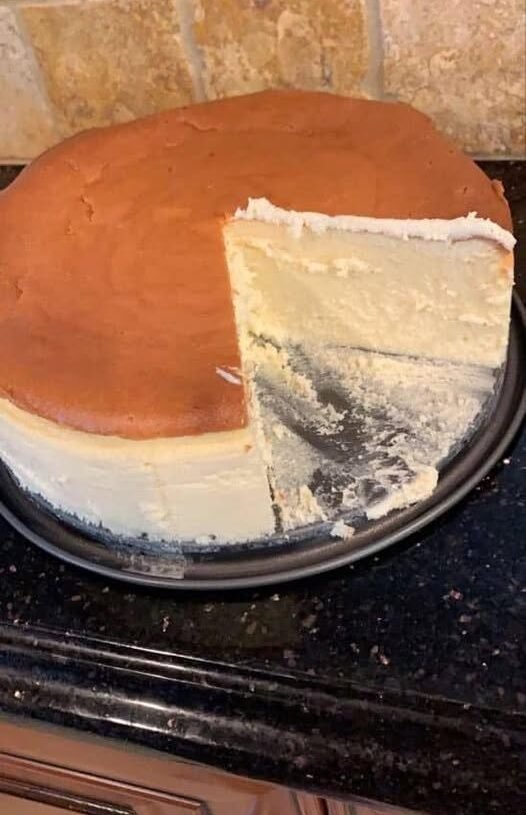
- Prep time: 30 minutes
- Bake time: 1 hour 15 minutes
- Cooling/Chilling time: 8 hours (minimum)
- Yield: 12–16 slices
- Pan Size: 9-inch (23 cm) Springform Pan
Equipment Needed
- 9-inch Springform Pan
- Heavy-duty Aluminum Foil (18-inch wide works best)
- Large Roasting Pan (for the water bath)
- Electric Stand Mixer or Hand Mixer
- Rubber Spatula
Ingredients
For the Graham Cracker Crust
- 1 ½ cups (150g) Graham cracker crumbs (approx. 10–12 full sheets, finely crushed)
- ¼ cup (50g) Granulated sugar
- 6 tbsp (85g) Unsalted butter, melted
- ¼ tsp Fine sea salt
For the Cheesecake Filling
- 32 oz (900g/4 blocks) Full-fat cream cheese, room temperature (brick-style, e.g., Philadelphia)
- 1 cup (200g) Granulated sugar
- 1 cup (240g) Full-fat sour cream, room temperature
- 1 tsp Pure vanilla extract
- 1 tsp Fresh lemon juice
- 1 tsp Fresh lemon zest (finely grated)
- 3 tbsp All-purpose flour
- 4 large Eggs, room temperature
- 1 large Egg yolk, room temperature
Step-by-Step Instructions
Step 1: Prep the Oven and Springform Pan
- Position an oven rack in the lower-third section of your oven. Preheat to 325°F (160°C).
- Lightly grease the bottom and sides of a 9-inch springform pan.
- Water-proof the pan: Wrap the outside bottom and sides of the springform pan with 3 to 4 overlapping layers of heavy-duty aluminum foil to ensure no water leaks in during the water bath.
Step 2: Make and Bake the Crust
- In a medium bowl, combine the Graham cracker crumbs, sugar, melted butter, and salt. Stir until the mixture resembles wet sand.
- Pour the crumbs into the prepared pan. Press firmly and evenly into the bottom and slightly up the sides using the bottom of a measuring cup.
- Bake for 10 minutes at 325°F (160°C). Remove from the oven and set aside to cool completely while making the filling.
Step 3: Prepare the Filling
Crucial Tip: Beat at low speed throughout the process to avoid introducing excess air bubbles, which cause cracks during baking.
- In a large mixing bowl (or stand mixer fitted with the paddle attachment), beat the room-temperature cream cheese and sugar together on low speed for 2 minutes until smooth and creamy. Scrape down the sides and bottom of the bowl.
- Add the sour cream, vanilla extract, lemon juice, lemon zest, and flour. Beat on low speed just until combined and smooth.
- Add the eggs and egg yolk one at a time, mixing on low speed after each addition just until blended. Do not overmix.
Step 4: Assemble and Prepare the Water Bath
- Pour the cream cheese mixture over the cooled crust. Smooth the top with a spatula.
- Place the wrapped springform pan inside a large, high-sided roasting pan.
- Bring 2–3 quarts of water to a boil. Carefully pour the boiling water into the roasting pan around the springform pan, reaching about halfway up the sides of the cheesecake pan.
Step 5: Bake and Gentle Cool Down
- Bake at 325°F (160°C) for 70 to 80 minutes.
- How to test for doneness: The edges should look set and slightly puffed, but the center (about 2–3 inches in the middle) should still have a gentle wobble when you lightly shake the pan.
- Turn off the oven, crack the oven door open slightly (about 1–2 inches), and let the cheesecake sit inside the warm oven for 1 hour. This gradual cooling prevents the top from cracking.
Step 6: Chill
- Carefully remove the springform pan from the water bath, remove the aluminum foil, and place the cheesecake on a wire rack.
- Run a thin knife gently around the inside rim of the pan to loosen the edges (this prevents sticking as it shrinks while cooling).
- Let it cool completely at room temperature (about 1–2 hours).
- Cover loosely with plastic wrap and refrigerate for at least 8 hours, preferably overnight.
How to Slice Cleanly
- Remove the outer ring of the springform pan before serving.
- Use a long, sharp knife dipped in hot water, wiped dry with a paper towel before every single cut.
Baker’s Tips for Success
- Room Temperature Ingredients: Make sure the cream cheese, sour cream, and eggs are at true room temperature (leave them out for 1 to 2 hours before baking). Cold ingredients cause lumps and require over-beating.
- Low Speed is Key: Over-whipping introduces air, causing the cake to puff up like a souffle in the oven and collapse/crack as it cools.
- Do Not Skip the Water Bath: The humidity regulates baking heat, resulting in a silkier texture and crack-free top.